
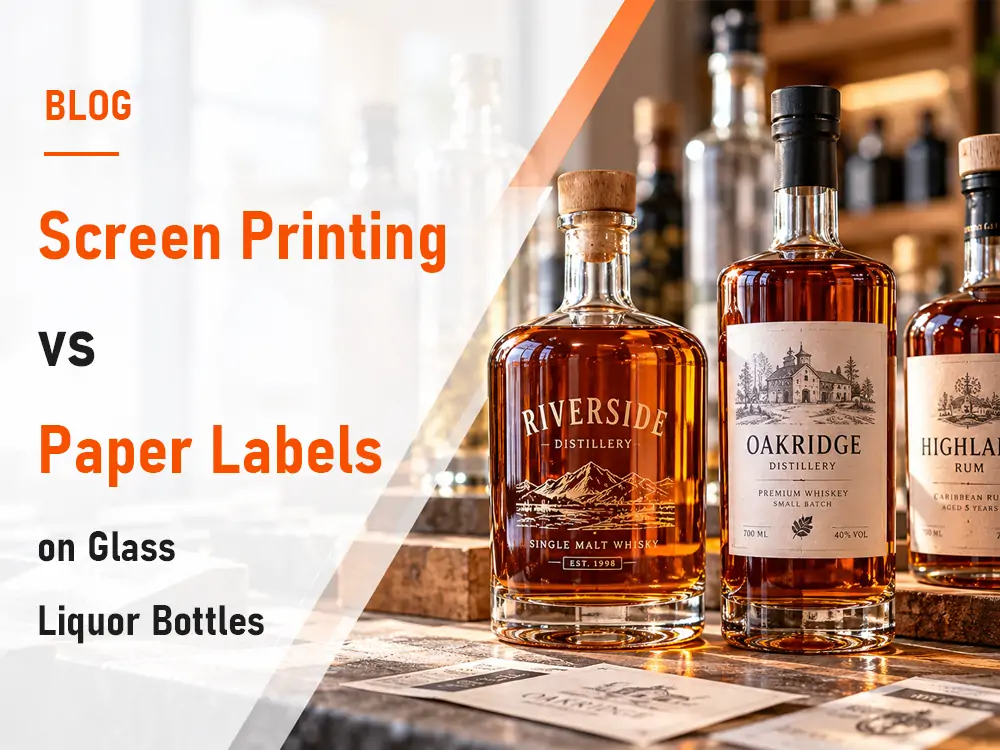
The debate on screen printing vs paper labels on glass liquor bottles is not new. Brands have used both methods for years. However, opinions are mixed when it comes to choosing between the two. As you know, branding and prints on glass bottles are crucial. Without them, liquor bottles look boring, and customers don’t notice them.
These printing methods perform differently when used on glass bottles. Many people favor screen printing for durable designs on glass bottles. However, others favor label printing. This difference of opinion can make it confusing to choose between these two printing methods. In this article, I will discuss the differences between these methods. So, let’s get started.
Overview of Screen Printing & Paper Labels
Screen printing technique involves the use of mesh, a stencil, and ink. The ink is transferred to the bottle using a mesh screen to create the design. The ink cures and dries, creating permanent designs on bottles. Paper label printing involves creating a paper label with a specific design. This label is then applied to the surface of bottles.
In screen printing, the stencil is made with a specific design. After that, it is placed on the mesh screen. The operator then presses the ink with a squeegee. This pushes the ink through the open areas of the stencil. It goes through the mesh screen onto the surface of the glass bottle. After that, the ink cures so it dries quickly. Generally, UV light is used in the curing process.
The ink dries, solidifies, and makes a permanent design on the surface of the bottles. This design becomes part of the glass and cannot be removed. In contrast, paper labels are made from separate paper. They contain the design you want on the surface of the glass bottles. Once the label is ready, it is applied to the bottle surface, removing the paper from the sticky area.
This way, the label consisting of your design or logo sticks to the bottle surface. What makes this printing type stand out is its ease of application. Additionally, you can also remove the label and add a new one whenever you need. Paper label prints are not resistant to moisture or high temperatures.
These prints can fade in harsh conditions, which reduces their durability. Remember, paper labels can be made from different types of paper. Different paper types give glass bottles different surface finishes. Different paper label types are available, and they differ in how they are applied to glass liquor bottles.
Differences Between Screen Printing & Paper Labels For Glass Liquor Bottles
Remember, both screen printing and paper labels are used on liquor glass bottles. However, these two methods differ in many ways. Understanding these distinctions is key to choosing the right printing method for your liquor bottles. In the section below, I will explore their fundamental differences.
1- Application Method & Adhesive Requirement
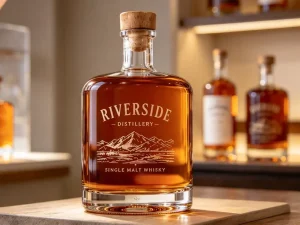
These two printing methods work differently. Screen printing does not use adhesive or glue. Instead, this method uses a screen printer, ink, a stencil, and a mesh screen. Ink passes through the mesh screen onto the bottle, creating a print. The ink dries and permanently attaches to the surface of the liquor bottle.
On the other hand, paper label printing involves the use of adhesive. In this method, you first print the paper and then attach it to the liquor bottle using glue or adhesive. In some paper labels (Pressure-sensitive labels), the adhesive is already present on the label. You won’t have to use it separately. These paper labels are very easy to apply to glass bottles.
2- Appearance (Color Options) & Visual Appeal
Screen printing creates prints with excellent detail. These prints look visually appealing and very neat on the surface of a glass liquor bottle. However, when it comes to color options, this method falls short. Generally, screen printing is limited to a few colors. Additionally, for each color, you’ll have to use a separate screen. That’s why complex multi-color artwork is very difficult with screen printing.
In contrast, paper labels offer decent visual appeal. Moreover, this printing method offers more freedom when it comes to the number of colors. You can print and design logos in color using this method. I rank screen printing high for visual appeal, but label printing stands out for its greater color flexibility.
3- Durability & Customization
Screen printing stands out for the durability of prints on glass liquor bottles. This method uses ink to form designs or prints on the liquor bottles. Once cured, the ink is permanently bonded to the bottle’s surface, so moisture, scratches, and physical contact don’t affect it. On the other hand, paper labels are prone to peeling and fading.
Additionally, they can get scratched, which raises questions about their durability. I highly recommend paper label printing for customization. You can simply remove the old label and add a new label with a unique design. Additionally, these labels come in a range of shapes and sizes, giving you more customization. Screen printing isn’t the best option if you want more customization.
4- Production Volume & Setup
Screen printing requires initial setup and equipment. These include a mesh screen, stencil, ink, color separator, and more. You’ll need to arrange everything before you start. Once the setup is ready, you can print hundreds of glass liquor bottles. This means screen printing is best for high production volumes.
For small production, this method may not be ideal because of the initial setup cost. In contrast, paper label printing is best suited for small production. You don’t need a complex setup, which makes it much easier to use. You can also change the design and pattern when using this printing method. Paper labels are the best option for small-scale production.
5- Resistance to Moisture & Scratches
Screen printing creates designs and prints on glass liquor bottles that last for years. As mentioned above, this method uses ink and passes it through a curing process. After curing, the ink permanently attaches to the surface of a glass liquor bottle. It is not affected by rain, moisture, or scratches. Continuous handling and rough touches do not affect it.
On the other hand, paper labels are prone to peeling off. This is because these labels are applied with adhesive. They do not permanently attach to the bottle surface. When exposed to moisture or sunlight, these labels can fade. Therefore, you’ll need to remove these labels once they fade. Screen-printed labels will stay on glass liquor bottles for years and withstand harsh use.
6- Design Changes & Flexibility
Paper labels offer excellent flexibility. You can easily change the design and apply a new label to the glass bottle. As mentioned above, these labels are applied with adhesive. This means they don’t bond permanently with the glass surface. So removing them is very easy. You can remove the old label and attach a new label with an updated design or logo.
On the other hand, screen printing offers less flexibility. This is because the ink forms a permanent bond with the glass surface. Because of this strong bond, the ink cannot be removed. Once a design is made, it will remain on the surface of glass liquor bottles. People always choose paper labels when they need temporary branding.
7- Cost-Effectiveness & Ideal Use Case
Screen printing is very expensive, which is a major drawback. This is because the method involves a complex setup. Screen printing can cost even more when you’re using it for a small production volume. For larger production volumes, the cost can be reduced to some extent. Conversely, paper labels have very minimal setup costs.
This makes this printing method very cost-effective even for smaller production volumes. Additionally, you can remove them if you want to update the design or logo on the liquor bottle. Below is the table showing the best use of these printing methods:
| Screen Printing | Paper Labels |
| Large-volume production | Small-batch production |
| Consistent designs | Frequent design changes |
| Premium, minimalist bottles | Detailed artwork |
| High moisture exposure | Seasonal or limited editions |
| Long-term branding | Multiple product variations |
| Durable packaging | Cost-effective flexibility |
Frequently Asked Questions
Can I screen print on glass bottles?
Yes. You can make high-quality designs, logos, and other patterns on glass bottles using screen printing. These prints are durable and resistant to fading and peeling.
Is screen printing better than paper labels for liquor bottles?
Yes. Screen printing is more durable than paper labels. The ink forms a permanent bond with the glass surface and doesn’t peel off. However, paper label methods also offer some benefits over screen printing.
Are screen-printed glass bottles recyclable?
Yes. Glass bottles with screen prints are recyclable. In fact, they are recycled just like any other glass bottle.
Conclusion: Which One Should You Choose for Liquor Bottles, Screen Printing or Paper Labels?
As discussed, both of these printing methods are excellent in different ways. That’s why choosing between them can be confusing, especially if you’re new to the liquor business.
I recommend screen printing for high-quality, durable prints on glass liquor bottles. These prints will last for years, won’t fade, and will stay sharp. They also won’t get scratched during handling. If you’re on a tight budget and need a flexible option, paper label printing also makes sense. However, this method doesn’t provide durable prints on glass bottles.
What I like about paper labels is that they’re easy to apply and remove. You can apply them to your liquor glass bottles. When you want to change them, you simply remove the old label and apply a new one. This gives you the flexibility to keep changing labels over time. In this article, I discuss the key differences between screen printing and paper labels. You can analyze these distinctions and choose the right liquor glass bottles.
